
conventionné avec le Ministère de la Culture


DE
Zusammenfassung
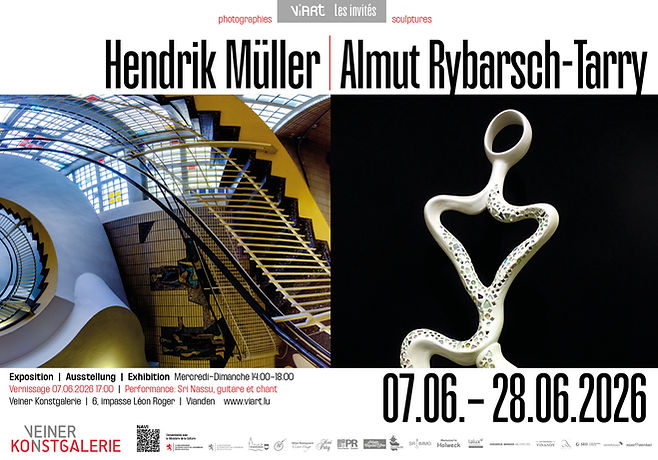
Skulptur und Fotografie erscheinen auf den ersten Blick als nicht leicht vereinbar. Dabei gibt es bei den Werken von Almut Rybarsch-Tarry und Hendrik Müller – auch durch den gemeinsamen Austausch – thematische Überschneidungen. Die Skulpturen der Free Flow Serie von Almut Rybarsch spielen mit sinnlichen Formen – eine Verlockung, die sich in den erotischen Fotografien von Hendrik Müller wiederfindet, während in den Panoramen von Hendrik Müller und den Serien 'Stadtgesichter' und 'Habenichse' von Almut Rybarsch-Tarry die Wahrnehmung unseres Umfelds hinterfragt wird.
Zwei verwandte Seelen – Skulptur & Fotografie
Sowohl künstlerisch als auch privat verbinden Hendrik Müller und Almut Rybarsch-Tarry lange Jahre der Freundschaft und des kreativen Schaffens. Trotz der unterschiedlichen Arbeitssparten sehen sie immer wieder Gemeinsamkeiten und Bezugnahme aufeinander in ihren künstlerischen Prozessen und Werken. Um dies zu zeigen haben die Künstler für die Ausstellung in Vianden Arbeiten ausgesucht, in denen sie sich inhaltlich und/oder ästhetisch treffen.
Die gemeinsame Werkschau von Almut Rybarsch-Tarry und Hendrik Müller bringt ähnliche Sicht-und Denkweisen in sehr unterschiedlichen künstlerischen Arbeitsweisen zusammen: so setzen sie sich zum einen mit der Ästhetik des menschlichen Körpers, weiblich wie männlich, auseinander, in abstrakten, plastischen Figuren, deren Sinnlichkeit sich auch ohne eindeutige Geschlechtsmerkmale entfaltet und mit fließenden Konturen zur gewollten Berührung einladen sowie erotischen Aktfotografien die Formen und Schönheit des menschlichen Körpers herausarbeiten, die sich nicht sofort offenbaren. Zum anderen treibt die Künstler die Sichtbarmachung der Folgen menschlichen Handelns oder vielmehr Nichthandelns um. Hendrik Müllers großformatige Panoramabilder zeigen verlassene Gebäude und zum Teil nie fertig gestellte Verkehrssysteme, die durch den Wiedereinzug der Natur und gemächlichen Verfall zwar einen neuen Charme erhalten, aber letztlich doch als Überbleibsel von Ignoranz, Fehlplanung, Spekulation gelten können. Die realitätsnahen Stadtgesichter von Almut Rybarsch-Tarry bilden Prototypen nach, die uns an vielen Orten begegnen können: Menschen, gezeichnet durch die prekären Lebensumstände oder stolz auf ihre gelungene Selbstoptimierung oder einfach froh, sich zeigen zu können, wie sie sind.
Die von Hendrik Müller ausgestellten Werke, C-Prints oder 8-Farb Prints auf unterschiedlichen Trägern (PE-Papier, Dibond, Acryl), lassen sich in folgende Themenbereiche einteilen: Panoramen und erotisch notierte Fotografien. Bei den Panoramen handelt es sich hauptsächlich um Lost Places, städtische Räume und Verkehrssysteme. Hier geht es dem Künstler um die umfassende Wirkung dieser Orte auf den Betrachter und wie sich die Menschen darin verhalten. Die Fotos von Lost Places sind oft menschenleer, Menschen in diesen Fotografien wirken klein und verloren. Mensch und Umwelt werden zueinander in Relation gestellt. Der Künstler suchte die abgebildeten Orte gezielt wegen ihrer Geschichte und Wirkung auf. Die Werke fragen nach den Auswirkungen unseres Handelns und dem Einfluss von Architektur auf den Menschen, aber auch danach, was nach dem vermeintlichen Ende eines Ortes noch weiter mit ihm geschieht.
Die erotisch notierten Fotografien widmen sich der Form menschlicher, meist männlicher Modelle und sollen Formen und Schönheit herausarbeiten wo sie nicht unbedingt auf den ersten Blick sichtbar sind. Die Modelle sind für den Künstler eine Inspiration an sich und werden vom Künstler gezielt wegen bestimmter Körpermerkmale bzw. für bestimmte künstlerische Projekte angesprochen.
Die generelle Botschaft des Künstlers an die Betrachter ist: 'öffne Deinen Blick für das Schöne'. Im speziellen möchte er bei der aktuellen Ausstellung die Betrachter dazu auffordern, ihr Handeln und den Sinn ihres Einflusses zu hinterfragen.
Die von Almut Rybarsch-Tarry ausgestellten Werke gehören zu den Serien Free Flow´s, Stadtgesichter und Habenichtse sowie einige Einzelwerke Die Werkgruppe Free Flow´s zeigt abstrakte, jedoch eindeutig weibliche Körperformen, teils fließend, vielfach durchbrochen und langgezogen, eine ständige Suche nach dem Wesentlichen, welches sich mehr auf die innere Haltung als die äußere Form bezieht. Dazu gehört das Spezifikum des gesichtslosen Kopfes, einem ausgehöhlten Oval, der ein freies fließen von Gedanken, Emotionen und Energie assoziiert. Die Stadtgesichter kommen und gehen seit 2010 und spiegeln den weitläufigen, sehr gemischten Teil ihres Umfeldes wieder. Der Fokus liegt auf optischen Merkmalen sozialer Hintergründe und individueller Lebensstile, die von der Künstlerin hinein vermutet werden. Beschränkt auf Kopf und eben nötige Körperformen, sind es vor allem die zum Teil ausufernden Details, die sowohl den Reiz des Betrachtens als auch des Entstehungsprozesses ausmachen. Die limitiert als Abgüsse gefertigten Habenichtse stellen eine nicht personalisierte, als obdachlos zu lesende Person dar. Ein zunehmendes Problem durch steigenden Wohnraummangel, prekäre Arbeitsverhältnisse, restriktive Gesetzgebung und soziale Ausgrenzung.
Die Künstlerin möchte beim Betrachter Toleranz, Akzeptanz und positive Neugierde gegenüber Mitmenschen, deren Lebens und Sichtweisen auslösen. Für unsere Gesellschaften wünscht sie sich Empathie, Humor und ein respektvolles Miteinander, oder auch Nebeneinander wenn mehr nicht möglich ist.
Die ausgestellten Werke bestehen zum großen Teil aus Zementspachtelmasse auf Trägern wie Hartschaum, Aluminium-und Eisenrohr, sowie Glasflaschen (Stadtgesichter). Dazu kommen teilweise ungebrannter Ton, Gips und modellierbare Kunststoffe. Die sehr glatten Oberflächen entstehen durch intensives fein schmirgeln der aufmodellierten Spachtelschichten, werden in Schichten mit Acrylfarbe coloriert und mit Bootslack oder Acryllack mehrlagig versiegelt. Die aufbauende Technik des Modellierens erlauben der Künstlerin ein gewisses Maß an Veränderbarkeit im Prozess. Durch Abschlagen, Kratzen oder Schnitzen und ggf. anschließenden Neuauftrag kann die Form den Vorstellungen angepasst oder neu ausgerichtet werden.
Über die Künstler
Almut Rybarsch-Tarry, geboren 1967 in Dortmund, urspr. Ausbildung zur Hörgeräteakustikerin. Anschliessend Weiterbildung in Skulpturen- und Objektbau, plastischer Gestaltung, Bildhauerei. Seit 1996 freischaffende Künstlerin mit Wohnsitz und Atelier in Dortmund. Ausstellungen, Installationen, Kunst im öffentlichen Raum, Raum-Fassaden und Kulissengestaltung, Künstlerische Projektarbeit mit Kindern, Jugendlichen und geflüchteten Menschen für Museen, Schulen sowie private Träger und Vereine, Organisation von StreetArt und Graffiti-Projekten. Die Künstlerin ist Mitglied in lokalen Kunst-und Kulturvereinen, sowie im Bund Bildender Künstler.
Als Künstlerin setzt sie sich intensiv mit Menschen, deren Lebensumständen, Politik und Umwelt auseinander, sucht nach Aspekten die sie berühren, um sie in eine für die Betrachter nachvollziehbare und für sie authentische Form zu bringen. Die Künstlerin lässt sich gerne in die Lebenswelten anderer Menschen hineinziehen und bezeichnet sich selbst als eine gute Zuhörerin und Beobachterin, redet jedoch nicht gerne über sich selbst und lässt lieber ihre Arbeiten für sie sprechen.
Almut Rybarsch-Tarry arbeitet mit verschiedenen Materialien, wie Zement-und Spachtelmasse auf unterschiedlichen Trägern (u.a. Metall, Kunststoff, Hartschaum), aber auch mit Gusstechniken (Gips, Kunststoff, Aluminium und Bronze). Sie interessiert sich für die Auseinandersetzung und Darstellung aller sowohl menschlichen als auch tierischen Lebewesen in allen Facetten, sowie den Einfluss von Umweltbedingungen, Politik und Lebensumständen auf unsere Gesellschaften und wie wir als Individuen oder Gruppen selber Einfluss erhalten und nutzen können.
Die Begeisterung für Fotographie packte Hendrik Müller bereits im Alter von 13 Jahren. Durch die Tätigkeit als Prozessbetreuer im Großlabor und als Projektionist bzw. Kinotechniker konnte er erste professionelle Erfahrungen sammeln, erste künstlerische Anwendungen des Mediums ab dem 20 Lebensjahr. Die Intention, künstlerisch zu arbeiten kam in ihm in dem Bestreben auf, für Andere sichtbar zu machen was ihn berührt, auch, um Dinge zu bewahren die, oft unbemerkt, verschwinden. Hendrik Müller ist Autodidakt, ein Studium der Fotografie blieb ihm leider verwehrt. Der Künstler war neben seinem Künstlerdasein 35 Jahre als Pflegekraft in der Intensivmedizin, seit vier Jahren arbeitet er nur noch künstlerisch in seinem Atelier in Dortmund.
Heute fotografiert er digital, eine analoge Herangehensweise ist jedoch bei vielen seiner Arbeiten noch erkennbar. Schwerpunkte seiner Arbeit: Der Mensch an sich und die Schönheit des Menschen, sowie der Einfluss des Menschen auf das was ihn umgibt.
1969 geboren hatte Hendrik Müller die Gelegenheit, verschiedene geschichtliche Ereignisse mitzuerleben, die ihn in seinem Denken und Handeln prägen sollten, so der Widerstand gegen die Atompolitik in Bayern und der Reaktorunfall in Tschernobyl. Ereignisse wie diese brachten den Künstler früh auf das Paradox des gesellschaftlichen Anspruchs im Vergleich zum Gesellschaftlichen Handeln. Die Zuwendung zur Aktfotografie wurde ausgelöst durch die Wucht der AIDS-Pandemie, die den, damals 18 Jahre alten, sich selbst als homosexuell definierenden Künstler in einer Phase seines Lebens trafen in der er sich eigentlich hätte unbeschwert ausprobieren wollen. Die Entwicklung hin zu Lost-Places und Panorama-Fotografie fand in seinen Dreißigern statt und hat sich bis heute von analogen Verfahren hin zu digitalen Techniken entwickelt bzw. erhalten. Hendrik Müller nutzt neben der Fotografie die Programmierung von virtuellen Durchgängen um Erinnerungsprojekte zu verschwundenen oder schwer zugänglichen Orten zu realisieren und sie dadurch weiterhin zugänglich und verständlich zu machen. Gelegentlich, wenn notwendig, greift der Künstler auch auf Videografie und Audio-Aufnahmen zurück.
Gemeinsame Projekte
Vor vier Jahren entstand in Zusammenarbeit mit Almut Rybarsch-Tarry eine skulpturale Arbeit: Das 'Velostudio', gleichermaßen Skulptur und Arbeitsmedium.
Das "Velostudio" nutzt Hendrik Müller als ein mit dem Fahrrad transportabler Arbeitsplatz und Energiequelle für fotografische Arbeiten. Gleichermaßen ist es aber auch ein Vehikel zur Verbildlichung der prekären Lebenssituation von Künstlern.
FR
En résumé
Sculpture et photographie peuvent sembler incompatibles au premier abord. Pourtant, les œuvres d'Almut Rybarsch-Tarry et d'Hendrik Müller révèlent des points communs thématiques, notamment grâce à leurs échanges artistiques. Les sculptures de la série « Free Flow » d'Almut Rybarsch explorent des formes sensuelles, un thème que l'on retrouve dans les photographies érotiques d'Hendrik Müller. Parallèlement, les panoramas de Müller et les séries « City Faces » et « Habenichse » d'Almut Rybarsch-Tarry interrogent notre perception de l'environnement.
Deux âmes sœurs – sculpture et photographie
Tant sur le plan artistique que privé, Hendrik Müller et Almut Rybarsch-Tarry sont liés par de longues années d'amitié et de création. Malgré leurs domaines de travail différents, ils ne cessent de découvrir des points communs et des références mutuelles dans leurs processus artistiques et leurs œuvres. Pour illustrer cela, les artistes ont sélectionné pour l'exposition de Vianden des œuvres dans lesquelles ils se rejoignent sur le fond et/ou sur le plan esthétique.
L'exposition commune d'Almut Rybarsch-Tarry et d'Hendrik Müller rassemble des perspectives et des modes de pensée similaires au sein de pratiques artistiques très différentes : d'une part, ils explorent l'esthétique du corps humain, féminin comme masculin, à travers des figures abstraites et plastiques dont la sensualité s'épanouit même en l'absence de caractéristiques sexuelles évidentes et qui, par leurs contours fluides, invitent au toucher ; d'autre part, des photographies érotiques de nus font ressortir les formes et la beauté du corps humain qui ne se révèlent pas immédiatement. D'autre part, l'artiste s'attache à rendre visibles les conséquences de l'action humaine, ou plutôt de l'inaction. Les images panoramiques grand format de Hendrik Müller montrent des bâtiments abandonnés et des réseaux de transport en partie jamais achevés, qui acquièrent certes un nouveau charme grâce à la reconquête de la nature et à leur lente dégradation, mais peuvent finalement être considérés comme les vestiges de l'ignorance, d'une mauvaise planification et de la spéculation. Les visages urbains réalistes d’Almut Rybarsch-Tarry reproduisent des prototypes que l’on peut rencontrer en de nombreux endroits : des personnes marquées par des conditions de vie précaires, fières de leur réussite personnelle ou simplement heureuses de pouvoir se montrer telles qu’elles sont.
Les œuvres exposées par Hendrik Müller, des tirages C-Print ou des tirages en 8 couleurs sur différents supports (papier PE, Dibond, acrylique), peuvent être classées dans les thèmes suivants : panoramas et photographies à connotation érotique. Les panoramas représentent principalement des lieux abandonnés, des espaces urbains et des réseaux de transport. L’artiste s’intéresse ici à l’effet global de ces lieux sur le spectateur et au comportement des personnes qui s’y trouvent. Les photos de lieux abandonnés sont souvent désertes ; les personnes qui y apparaissent semblent petites et perdues. L’homme et l’environnement sont mis en relation l’un avec l’autre. L’artiste a délibérément recherché les lieux représentés en raison de leur histoire et de leur impact. Les œuvres interrogent les répercussions de nos actions et l’influence de l’architecture sur l’être humain, mais aussi ce qu’il advient d’un lieu après sa fin supposée.
Les photographies à connotation érotique se concentrent sur les formes des modèles humains, principalement masculins, et visent à faire ressortir des formes et une beauté qui ne sont pas forcément visibles au premier regard. Les modèles sont une source d’inspiration en soi pour l’artiste, qui les sollicite spécifiquement en raison de certaines caractéristiques physiques ou pour des projets artistiques particuliers.
Le message général de l’artiste au spectateur est : « ouvre ton regard à la beauté ». Dans le cadre de l’exposition actuelle, il souhaite en particulier inviter les spectateurs à s’interroger sur leurs actions et le sens de leur influence.
Les œuvres exposées par Almut Rybarsch-Tarry font partie des séries « Free Flow’s », « Stadtgesichter » et « Habenichtse », ainsi que quelques œuvres individuelles. Le groupe d’œuvres « Free Flow’s » présente des formes corporelles abstraites, mais clairement féminines, en partie fluides, souvent ajourées et allongées, une quête constante de l’essentiel, qui se rapporte davantage à l’attitude intérieure qu’à la forme extérieure. En fait partie la spécificité de la tête sans visage, un ovale évidé qui évoque un libre flux de pensées, d’émotions et d’énergie. Les « Stadtgesichter » vont et viennent depuis 2010 et reflètent la partie vaste et très hétérogène de son environnement. L’accent est mis sur les traits visuels des origines sociales et des modes de vie individuels que l’artiste suppose. Limitées à la tête et aux formes corporelles strictement nécessaires, ce sont surtout les détails parfois débordants qui constituent tout l’attrait tant de l’observation que du processus de création. Réalisés en série limitée sous forme de moulages, les « Habenichtse » représentent une personne non personnalisée, pouvant être interprétée comme un sans-abri. Un problème croissant dû à la pénurie de logements, à la précarité de l’emploi, à une législation restrictive et à l’exclusion sociale.
L'artiste souhaite susciter chez le spectateur de la tolérance, de l'acceptation et une curiosité bienveillante envers ses semblables, leur vie et leurs points de vue. Pour nos sociétés, elle aspire à l'empathie, à l'humour et à une coexistence respectueuse, ou tout au moins à une cohabitation s'il n'est pas possible d'aller plus loin.
Les œuvres exposées sont en grande partie réalisées à partir de mastic de ciment appliqué sur des supports tels que de la mousse rigide, des tubes en aluminium et en fer, ainsi que des bouteilles en verre (visages urbains). À cela s’ajoutent parfois de l’argile non cuite, du plâtre et des plastiques modelables. Les surfaces très lisses sont obtenues par un ponçage fin et intensif des couches de mastic modelées ; elles sont colorées par couches de peinture acrylique et
scellées par plusieurs couches de vernis pour bateaux ou de vernis acrylique. La technique constructive du modelage permet à l’artiste une certaine marge de manœuvre au cours du processus. En enlevant, grattant ou sculptant la matière, puis en appliquant éventuellement une nouvelle couche, la forme peut être adaptée aux idées ou réorientée
À propos des artistes
Almut Rybarsch-Tarry, née en 1967 à Dortmund, a d'abord suivi une formation d'audioprothésiste. Elle a ensuite suivi une formation complémentaire en sculpture et construction d'objets, en création plastique et en sculpture. Depuis 1996, artiste indépendante résidant et travaillant dans son atelier à Dortmund. Expositions, installations, art dans l’espace public, conception de façades et de décors, projets artistiques avec des enfants, des jeunes et des réfugiés pour des musées, des écoles ainsi que des organismes privés et des associations, organisation de projets de street art et de graffitis. L'artiste est membre d'associations artistiques et culturelles locales, ainsi que de l'Union des artistes plasticiens. En tant qu'artiste, elle s'intéresse de près aux personnes, à leurs conditions de vie, à la politique et à l'environnement, et recherche les aspects qui la touchent afin de les transposer sous une forme compréhensible pour le spectateur et authentique pour elle-même.
L'artiste aime se plonger dans les univers des autres et se décrit comme une bonne écouteuse et observatrice ; elle n'aime toutefois pas parler d'elle-même et préfère laisser ses œuvres parler pour elle.
Almut Rybarsch-Tarry travaille avec divers matériaux, tels que le ciment et le mastic sur différents supports (notamment le métal, le plastique, la mousse rigide), mais aussi avec des techniques de moulage (plâtre, plastique, aluminium et bronze). Elle s’intéresse à l’étude et à la représentation de tous les êtres vivants, tant humains qu’animaux, sous toutes leurs facettes, ainsi qu’à l’influence des conditions environnementales, de la politique et des conditions de vie sur nos sociétés, et à la manière dont nous pouvons, en tant qu’individus ou groupes, exercer et utiliser cette influence.
La passion pour la photographie a saisi Hendrik Müller dès l’âge de 13 ans. C'est en travaillant comme superviseur de processus dans un grand laboratoire et comme projectionniste ou technicien de cinéma qu'il a pu acquérir ses premières expériences professionnelles, puis commencer à explorer les applications artistiques de ce médium dès l'âge de 20 ans. Son intention de travailler artistiquement est née de son désir de rendre visible aux autres ce qui le touche, mais aussi de préserver des choses qui, souvent inaperçues, disparaissent. Hendrik Müller est autodidacte ; il n’a malheureusement pas pu suivre d’études de photographie. Parallèlement à sa vie d’artiste, il a travaillé pendant 35 ans comme soignant en soins intensifs ; depuis quatre ans, il se consacre exclusivement à la création artistique, dans son atelier de Dortmund.
Aujourd’hui, l’artiste photographie en numérique, mais une approche analogique reste perceptible dans nombre de ses œuvres. Thèmes centraux de son travail : l’être humain en soi et la beauté de l’être humain, ainsi que l’influence de l’être humain sur ce qui l’entoure.
Né en 1969, Hendrik Müller a eu l’occasion d’être témoin de divers événements historiques qui ont marqué sa pensée et son action, tels que la résistance contre la politique nucléaire en Bavière et l’accident nucléaire de Tchernobyl. Des événements comme ceux-ci ont très tôt confronté l’artiste au paradoxe entre les aspirations de la société et les actions concrètes de celle-ci. Son intérêt pour la photographie de nu a été déclenché par la violence de la pandémie du sida, qui a frappé l’artiste, alors âgé de 18 ans et se définissant comme homosexuel, à une période de sa vie où il aurait en réalité voulu s’épanouir sans souci. Son intérêt pour les lieux abandonnés et la photographie panoramique s’est développé dans la trentaine et s’est maintenu jusqu’à aujourd’hui, passant des procédés analogiques aux techniques numériques.
Outre la photographie, Hendrik Müller utilise la programmation de parcours virtuels pour réaliser des projets de mémoire sur des lieux disparus ou difficilement accessibles, afin de les rendre ainsi accessibles et compréhensibles. À l’occasion, lorsque cela s’avère nécessaire, l’artiste a également recours à la vidéographie et aux enregistrements audio.
Projets communs
Il y a quatre ans, une œuvre sculpturale a vu le jour en collaboration avec Almut Rybarsch-Tarry : le « Velostudio », à la fois sculpture et support de travail.
Hendrik Müller utilise le « Velostudio » comme un lieu de travail transportable à vélo et comme source d'énergie pour ses travaux photographiques. Mais c'est aussi un moyen de mettre en image la situation précaire des artistes.
EN
Summary
Sculpture and photography may not seem easily compatible at first glance. However, the works of Almut Rybarsch-Tarry and Hendrik Müller reveal thematic overlaps, partly due to their shared exchange of ideas. Almut Rybarsch's Free Flow series sculptures play with sensual forms – a theme echoed in Hendrik Müller's erotic photographs. Meanwhile, Müller's panoramas and Almut Rybarsch-Tarry's 'City Faces' and 'Habenichse' series question our perception of our surroundings.
Two Kindred Spirits – Sculpture & Photography
Both artistically and personally, Hendrik Müller and Almut Rybarsch-Tarry share a long friendship and creative partnership. Despite their different artistic disciplines, they consistently find common ground and connections to one another in their artistic processes and works. To demonstrate this, the artists selected works for the exhibition in Vianden that share common ground in terms of content and/or aesthetics.
The joint exhibition by Almut Rybarsch-Tarry and Hendrik Müller brings together similar perspectives and ways of thinking within very different artistic approaches. On the one hand, they explore the aesthetics of the human body, both female and male, in abstract, sculptural figures whose sensuality unfolds even without clearly defined gender characteristics and whose flowing contours invite the viewer to touch. On the other hand, erotic nude photographs highlight the forms and beauty of the human body that are not immediately apparent. The artists are also driven by the desire to make visible the consequences of human action, or rather, inaction. Hendrik Müller's large-format panoramic images depict abandoned buildings and, in some cases, never-completed transportation systems. While these structures acquire a new charm through the reclaiming of nature and gradual decay, they can ultimately be considered remnants of ignorance, misplanning, and speculation. Almut Rybarsch-Tarry's realistic urban portraits depict prototypes we encounter in many places: people marked by precarious living conditions, proud of their successful self-improvement, or simply happy to be able to show themselves as they are.
The works exhibited by Hendrik Müller – C-prints or 8-color prints on various substrates (PE paper, Dibond, acrylic) – can be categorized into the following thematic areas: panoramas and erotically charged photographs.
The panoramas primarily depict abandoned places, urban spaces, and transportation systems. Here, the artist explores the profound impact of these locations on the viewer and how people behave within them. The photographs of abandoned places are often deserted; the people in these images appear small and lost. Humanity and the environment are placed in relation to one another. The artist specifically sought out the depicted locations because of their history and impact. The works explore the impact of our actions and the influence of architecture on humanity, as well as what happens to a place after its supposed end.
The erotically charged photographs focus on the form of human, mostly male, models, aiming to highlight shapes and beauty where they are not immediately apparent. The models are an inspiration in themselves for the artist, who specifically approaches them for particular physical characteristics or for specific artistic projects.
The artist's general message to viewers is: "Open your eyes to beauty." Specifically, with this exhibition, he wants to encourage viewers to question their actions and the meaning of their influence.
The works exhibited by Almut Rybarsch-Tarry belong to the series Free Flows, City Faces, and Have-Nots, as well as several individual pieces.
The Free Flows series depicts abstract, yet distinctly female body forms, sometimes fluid, often fragmented and elongated, a constant search for the essential, which relates more to inner attitude than external form. This includes the distinctive feature of the faceless head, a hollowed-out oval that suggests a free flow of thoughts, emotions, and energy.
The City Faces series has been appearing and disappearing since 2010 and reflects the expansive, highly diverse nature of its surroundings. The focus is on visual characteristics of social backgrounds and individual lifestyles, which the artist perceives as being present. Limited to the head and the necessary body forms, it is primarily the sometimes extravagant details that constitute both the appeal of viewing and the creative process.
The limited-edition casts of these "Habennichts" (Have-Nots) represent an impersonal figure, interpreted as homeless. This reflects a growing problem due to increasing housing shortages, precarious employment, restrictive legislation, and social exclusion. The artist aims to evoke tolerance, acceptance, and positive curiosity in the viewer towards fellow human beings, their lives, and their perspectives. She hopes for empathy, humor, and respectful coexistence in our societies, or even coexistence when nothing more is possible. The exhibited works consist largely of cement-based filler on supports such as rigid foam, aluminum and iron tubing, and glass bottles (cityscapes). Unfired clay, plaster, and malleable plastics are also incorporated. The exceptionally smooth surfaces are achieved through intensive, fine sanding of the applied filler layers, colored in layers with acrylic paint, and sealed with multiple coats of boat varnish or acrylic lacquer. The constructive modeling technique allows the artist a degree of flexibility throughout the process. By chipping, scratching, or carving, and subsequently reapplying material if necessary, the form can be adapted or realigned to suit the artist's vision.
About the artists
Almut Rybarsch-Tarry, born in 1967 in Dortmund, originally trained as a hearing aid acoustician. She then pursued further training in sculpture and object construction, three-dimensional design, and sculpture. Since 1996, she has worked as a freelance artist, residing and studioing in Dortmund. Her work includes exhibitions, installations, public art, interior design, facades, and set design. She also conducts artistic projects with children, young people, and refugees for museums, schools, private institutions, and associations, and organizes street art and graffiti projects. The artist is a member of local art and cultural associations, as well as the Association of Visual Artists.
As an artist, she engages deeply with people, their living conditions, politics, and the environment, seeking aspects that resonate with her in order to translate them into a form that is both comprehensible and authentic for the viewer. The artist enjoys immersing herself in the lives of others and describes herself as a good listener and observer, but prefers not to talk about herself, letting her work speak for itself.
Almut Rybarsch-Tarry works with various materials, such as cement and filler on different supports (including metal, plastic, and rigid foam), as well as casting techniques (plaster, plastic, aluminum, and bronze). She is interested in exploring and depicting all aspects of human and animal life, as well as the influence of environmental conditions, politics, and living circumstances on our societies, and how we, as individuals or groups, can gain and utilize influence.
Hendrik Müller's passion for photography began at the age of 13. Through his work as a process supervisor in a large laboratory and as a projectionist and film technician, he gained his first professional experience, beginning his artistic exploration of the medium at the age of 20. Hendrik Müller's intention to work artistically arose from a desire to make visible to others what moves him, and also to preserve things that often disappear unnoticed. A formal photography education was unfortunately denied him. Alongside his artistic pursuits, he worked for 35 years as a nurse in intensive care. For the past four years, he has dedicated himself solely to his art in his studio in Dortmund. Today he photographs digitally, though an analog approach is still evident in many of his works. His work focuses on humanity itself and its beauty, as well as humanity's impact on its surroundings. Born in 1969, Hendrik Müller had the opportunity to witness various historical events that shaped his thinking and actions, such as the resistance against nuclear power in Bavaria and the Chernobyl reactor accident. Events like these introduced him early on to the paradox of societal aspirations versus societal actions. Hendrik Müller's turn to nude photography was triggered by the impact of the AIDS pandemic, which struck the then 18-year-old, self-identified gay artist at a time when he would have preferred to explore his sexuality freely. His focus on lost places and panoramic photography developed in his thirties and has since evolved from analog to digital techniques. In addition to photography, Hendrik Müller uses the programming of virtual tours to create memorial projects about vanished or difficult-to-access places, thereby making them accessible and understandable. Occasionally, when necessary, the artist also uses videography and audio recordings.
Joint Projects
Four years ago, in collaboration with Almut Rybarsch-Tarry, he created a sculptural work: the 'Velostudio,' which is both sculpture and working medium.
Hendrik Müller uses the 'Velostudio' as a workspace and energy source for his photographic work, transportable by bicycle. It is also a vehicle for visualizing the precarious living situation of artists.